Skip to main navigation Skip to main content

CMH : Clinical and Molecular Hepatology

OPEN ACCESS
ABOUT
BROWSE ARTICLES
FOR CONTRIBUTORS

Articles

Letter to the Editor

Non-alcoholic fatty liver disease and the risk of dementia: A meta-analysis of cohort studies

Clinical and Molecular Hepatology 2022;28(4):931-932.
Published online: September 5, 2022

1School of Medicine, Chung Shan Medical University, Taichung, Taiwan

2Department of Radiation Oncology, China Medical University Hospital, Taichung, Taiwan

3Department of Pharmacy, Chang Bing Show Chwan Memorial Hospital, Changhua, Taiwan

Corresponding author : Cheng-Hsien Hung Department of Pharmacy, Chang Bing Show Chwan Memorial Hospital, No.6, Lugong Rd., Lukang Township, Changhua 50544, Taiwan Tel: +886 47813888 (#71255), Fax: +886 47812966, E-mail: chenghsien823@gmail.com

Editor: Seung Up Kim, Yonsei University College of Medicine, Korea

• Received: August 29, 2022   • Revised: August 31, 2022   • Accepted: September 1, 2022

Copyright © 2022 by The Korean Association for the Study of the Liver

This is an Open Access article distributed under the terms of the Creative Commons Attribution Non-Commercial License (http://creativecommons.org/licenses/by-nc/3.0/) which permits unrestricted non-commercial use, distribution, and reproduction in any medium, provided the original work is properly cited.

  • 5,879 Views
  • 124 Download
  • 10 Web of Science
  • 8 Crossref
  • 10 Scopus
prev next
Dear Editor,
We read with great interest the a recent large-scale cohort study by Jeong et al. [1], which suggested that non-alcoholic fatty liver disease (NAFLD) was associated with a higher risk for incident dementia (adjusted hazard ratio, 1.05; 95% confidence interval [CI], 1.02–1.08; P=0.001), and was in agreement with another previous study [2]. However, we found that other studies have reported results that contradict the findings of the above studies [3-5]. Therefore, we performed a metaanalysis of cohort studies to investigate the association between NAFLD and the risk for dementia. Since the prevalence of NAFLD has increased significantly in recent years [6], it is critical to investigate any potential association with dementia.
Two authors independently searched PubMed and Embase records up to August 2022. “Non-alcoholic Fatty Liver Disease” and “Dementia” were searched for MeSH terms and free-text searches without language limitations. We included cohort studies reporting the association between NAFLD and dementia incidence, with data provided as hazard ratios and 95% CIs. The Newcastle-Ottawa scale for cohort studies was used to assess the quality of included studies. Two authors independently performed data extraction and quality assessment. Any conflicts were resolved by discussion or by consulting the third author. Of the 1,136 relevant published studies, 1,130 were excluded because they were not original studies (n=643), did not meet the inclusion criteria (n=311), or were duplicates (n=176). Eventually, six cohort studies, including the Jeong et al. [1] study, and other studies [3-5,7,8] were eligible. A total of 2,345,929 patients, with a mean age of 48.2–73.4 years, were included in the meta-analysis.
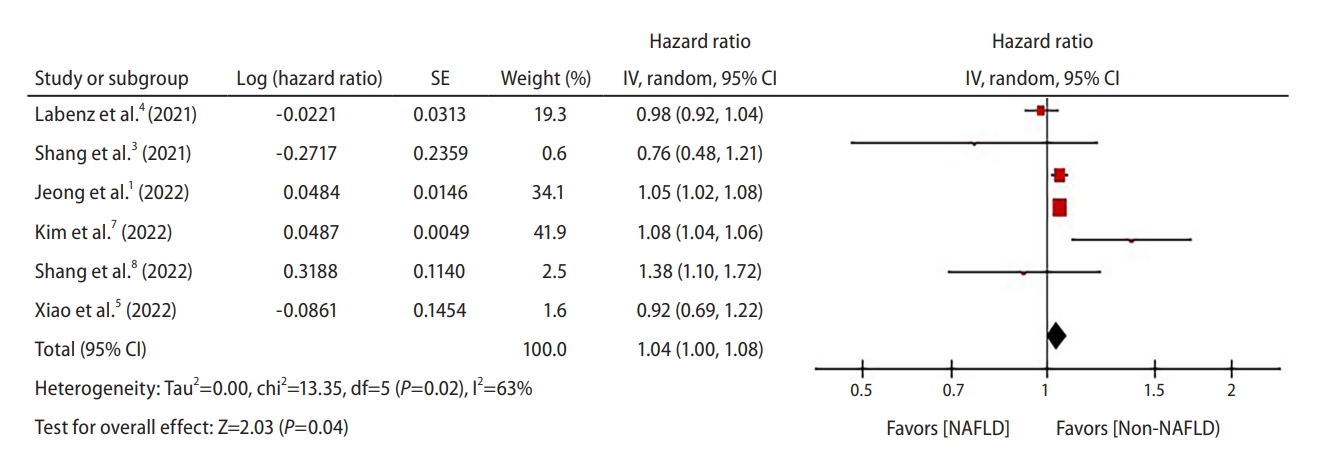
The RevMan 5.4 software (The Cochrane Collaboration, London, UK) was used to perform the meta-analysis and the I2 test was used to test heterogeneity. A random-effect model was used for the analysis. The pooled hazard ratio from six cohorts was 1.04 (95% CI, 1.00–1.08; P=0.04, I2=63%) (Fig. 1). Heterogeneity was high with an I2 of 63%. Sensitivity analyses were performed to assess the robustness of the meta-analysis. Each study was sequentially excluded for sensitivity analysis. The analysis showed that a few large studies affected the significance of the results [1,7]. However, a relationship between NAFLD and dementia was generally demonstrable. Further subgroup analyses are required to explore the causes of heterogeneity.
To the best of our knowledge, this was the first meta-analysis for the association between NAFLD and the risk for dementia. This meta-analysis indicated that NAFLD was a significant risk factor for dementia. However, due to the heterogeneity of statistical analyses, the results must be interpreted cautiously. Further prospective studies are needed to establish the relationship between NAFLD and dementia. Influence of other factors, including age, sex, ethnicity, and diagnosis, also requires further investigation.

Authors’ contributions

CHH conceived and designed the research; MYW and LYL contributed to the data acquisition; CHH and YSK analyzed the data and interpreted the results; LYL and CHH drafted, edited, and revised the manuscript; All authors reviewed the manuscript.

Conflicts of Interest

The authors declare no conflicts of interest.

Figure 1.
Forest plot of non-alcoholic fatty liver disease and the risk of dementia. SE, standard error; CI, confidence interval; NAFLD, non-alcoholic fatty liver disease.
cmh-2022-0259f1.jpg

CI

confidence interval

NAFLD

non-alcoholic fatty liver disease
  • 1. Jeong S, Oh YH, Choi S, Chang J, Kim SM, Son JS, et al. Association of non-alcoholic fatty liver disease with incident dementia later in life among elder adults. Clin Mol Hepatol 2022;28:510-521.
  • 2. Wang Y, Li Y, Liu K, Han X, Dong Y, Wang X, et al. Nonalcoholic fatty liver disease, serum cytokines, and dementia among rural-dwelling older adults in China: a population-based study. Eur J Neurol 2022;29:2612-2621.
  • 3. Shang Y, Nasr P, Ekstedt M, Widman L, Stål P, Hultcrantz R, et al. Non-alcoholic fatty liver disease does not increase dementia risk although histology data might improve risk prediction. JHEP Rep 2021;3:100218.
  • 4. Labenz C, Kostev K, Kaps L, Galle PR, Schattenberg JM. Incident dementia in elderly patients with nonalcoholic fatty liver disease in Germany. Dig Dis Sci 2021;66:3179-3185.
  • 5. Xiao T, van Kleef L, Ikram MK, De Knegt R, Ikram MA. Association of nonalcoholic fatty liver disease and fibrosis with incident dementia and cognition: the Rotterdam study. Neurology 2022;99:e565-e573.
  • 6. Park SH, Plank LD, Suk KT, Park YE, Lee J, Choi JH, et al. Trends in the prevalence of chronic liver disease in the Korean adult population, 1998-2017. Clin Mol Hepatol 2020;26:209-215.
  • 7. Kim GA, Oh CH, Kim JW, Jeong SJ, Oh IH, Lee JS, et al. Association between non-alcoholic fatty liver disease and the risk of dementia: a nationwide cohort study. Liver Int 2022;42:1027-1036.
  • 8. Shang Y, Widman L, Hagström H. Nonalcoholic fatty liver disease and risk of dementia: a population-based cohort study. Neurology 2022;99:e574-e582.

Download Citation

Download a citation file in RIS format that can be imported by all major citation management software, including EndNote, ProCite, RefWorks, and Reference Manager.

Format:

Include:

Non-alcoholic fatty liver disease and the risk of dementia: A meta-analysis of cohort studies
Clin Mol Hepatol. 2022;28(4):931-932.   Published online September 5, 2022
Download Citation

Download a citation file in RIS format that can be imported by all major citation management software, including EndNote, ProCite, RefWorks, and Reference Manager.

Format:
Include:
Non-alcoholic fatty liver disease and the risk of dementia: A meta-analysis of cohort studies
Clin Mol Hepatol. 2022;28(4):931-932.   Published online September 5, 2022
Close

Figure

  • 0
Non-alcoholic fatty liver disease and the risk of dementia: A meta-analysis of cohort studies
Image
Figure 1. Forest plot of non-alcoholic fatty liver disease and the risk of dementia. SE, standard error; CI, confidence interval; NAFLD, non-alcoholic fatty liver disease.
Non-alcoholic fatty liver disease and the risk of dementia: A meta-analysis of cohort studies